
Proteomics
Dissect the proteome to uncover key biomarkers and decode the mechanisms of life from the terminal executors of function.
Protein Identification
Protein qualitative analysis uses biochemistry and MS to systematically identify protein species, amino-acid sequences, post-translational modification (PTM) sites and structural features in a sample. It addresses the basic question of "which proteins are present," revealing known proteins, novel proteins, isoforms and abnormal modifications to support functional studies and biomarker screening. As key executors of life activities, protein amount and type directly affect physiological and pathological processes; qualitative analysis identifies and confirms protein species and structures, uncovering molecular networks and signaling pathways. It is widely used in medicine, agriculture and biotechnology—e.g., verifying drug targeting and side effects by comparing protein changes before and after treatment.
Principle Introduction
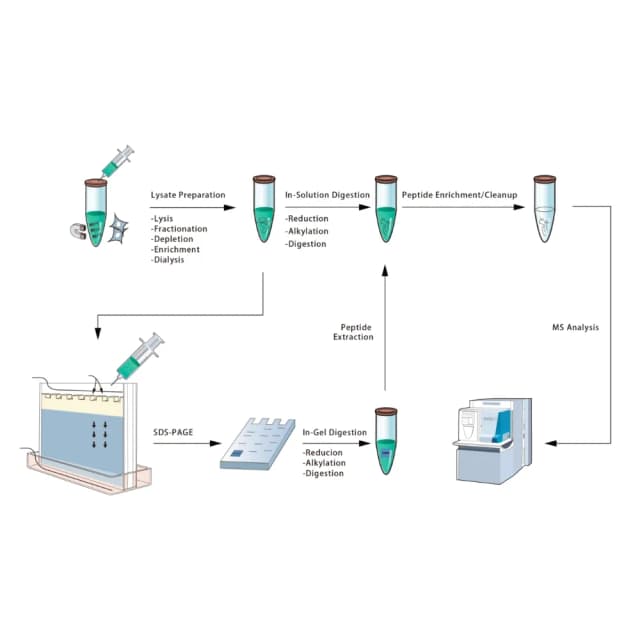
Protein qualitative analysis advances with MS technology. Labeled methods such as SILAC and iTRAQ introduce stable isotopes to compare protein abundance across samples. Workflow: sample pretreatment and extraction, protein separation/enrichment, peptide preparation, MS detection and data analysis, database searching.
Literature
In "Silicon-rhodamine-enabled near-infrared light-controlled proximity labeling for in vivo and in vitro protein interaction analysis" (Nature Communications), the SiR-based near-infrared proximity-labeling technique (SeeID) integrates fluorescence imaging and proximity labeling. Halo-Tag-bound SiR generates singlet oxygen under 660 nm light to oxidize neighboring histidines, covalently labeling proximal proteins (POI) for LC-MS/MS interactome parsing. With high spatial specificity (Pearson 0.83–0.94), deep tissue penetration (2 mm in mouse brain) and low toxicity, SeeID tracked Parkin-translocation interactome dynamics in PINK1/Parkin mitophagy, revealing early degradation mechanisms and providing an imaging-labeling tool for live-cell interaction studies.
Sample Requirements
fresh ≥100 mg (animal) or ≥300 mg (plant); FFPE 5–10 μm ≥10 slides, area ≥20 mm²;
adherent ≥2×10⁶; suspension ≥3×10⁶;
serum/plasma ≥1 mL (routine) or ≥3 mL (low-abundance); urine ≥5 mL, CSF ≥1 mL; saliva ≥3 mL;
pure protein ≥20 μg; recombinant/antibody ≥50 μg; peptide ≥10 μg.
Deliverables
QC report
sample quality (protein yield, peptide recovery/purity); MS quality (peptide/protein IDs, Q30, protein FDR); identification quality (average coverage, signature-peptide matches, PTM confidence).
Protein identification & annotation
high-confidence list (name, MW, pI, peptide matches, coverage, score); modification results (name, site, type, confidence); database annotation (function, localization, disease association, domains); novel-protein/isoform analysis.
Functional analysis
GO classification; KEGG enrichment (Top20); STRING-based core PPI network.
Interpretation report
main protein categories, key specific proteins, modification summary; biological significance and technical advantages.
FAQ
Increase sample, remove high-abundance proteins, pre-fractionate (2D electrophoresis or SCX), extend gradient/high-res MS, lower FDR threshold with bioinformatics.
2–3 technical repeats (≥90% consistency), cross-technique confirmation (Western blot/IF/ELISA), PRM validation of signature peptides, and multi-engine (Mascot/SEQUEST) database search.
