

Microbiomics
Deeply characterize host and environmental microbial communities to reveal the complex interplay between microbiota and health.
Shotgun Metagenomics
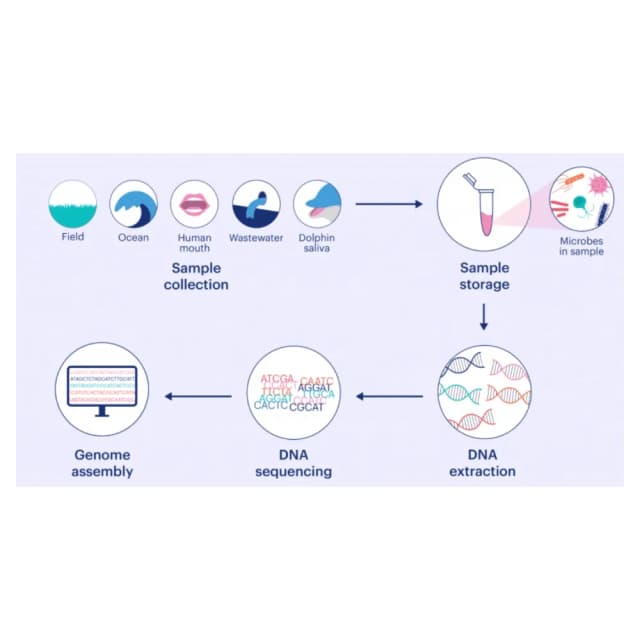
Metagenomics (microbial environmental or meta-genomics) bypasses isolation and culture, directly extracting and analyzing all microbial genetic material from environmental samples—a new route to study the >95% of uncultured microbes in nature. The workflow: extract total DNA from soil, water or secretions; sequence all microbial genomes at high throughput; bioinformatically align, assemble and annotate the data to identify species and relative abundance. It resolves community structure and discovers new functional genes. While culture-based methods detect ~1% of microbes, metagenomics captures all at once (common and rare). Clinically it detects pathogens like Leptospira missed by traditional methods. Now widely used in environmental microbiology, gene discovery, diagnostics and enzyme development; as costs fall and tools improve, culture-independent analysis is becoming a pillar of microbiology.
Principle Introduction
Metagenomics bypasses culture bottlenecks, directly extracting all microbial DNA (culturable and >99% uncultured) from environments (soil, water, gut). Mixed DNA is sequenced at scale; bioinformatics assembles, annotates and analyzes it to resolve diversity, function and interactions at community level. Total DNA is extracted, sheared (300–500 bp), library-built and shotgun-sequenced; QC'd reads are assembled into contigs or near-complete genomes. Species and functional annotation map reads to taxa and annotate gene functions via databases, revealing composition, potential and environmental interactions. Versus 16S amplicons, metagenomics needs no culture, resolves species/strain level and directly yields functional genes—powerful for new pathogens, bioactive compounds, pollution/climate responses and the microbiome-health axis.
Literature
Published in Cell, "Culture-independent meta-pangenomics enabled by long-read metagenomics reveals associations with pediatric undernutrition" used metagenomics to generate 986 circular metagenome-assembled genomes (cMAGs; 839 complete) from 47 fecal samples of a Malawi pediatric cohort. Machine learning identified key species predicting linear growth; pangenomics linked specific genes to growth and showed genome instability correlates with lower length-for-age Z-score (LAZ), setting a new standard for microbiome association studies and shifting metagenomics from descriptive to mechanistic.
Sample Requirements
≥1 g.
≥2 g.
≥2 mL, precipitate ≥1 g.
≥2 mL, precipitate ≥1 g.
≥2 g.
≥6.
≥20 mL or ≥10 g.
≥2 g.
≥2.
≥2.
Deliverables
QC report
GC content and length distribution charts.
Species annotation
phylum/class/order/family/genus/species abundance tables with bar/pie charts.
Functional analysis
KEGG pathway enrichment, COG classification, antibiotic resistance gene list.
Statistics
α/β diversity (Shannon, PCoA), differential analysis (p<0.05).
Custom report
pathogen identification, functional gene mining, etc.
FAQ
>2 samples with comparable design; for clearly grouped samples, ≥2 groups with ≥10 each to balance variation.
Simple (mammal gut) 5G clean data; complex (soil, ocean) 10G.
Avoid tissue-adjacent sampling; use host-removal kits; align against a reference genome to filter host DNA.
