
Genomics
From sequence to function — exploring the essence of life at the DNA level to power breakthroughs in basic research, breeding and clinical translation.
Whole-Exome Sequencing (WES)
Whole exome sequencing (WES) captures and enriches all exonic DNA via sequence capture, then sequences it at high throughput. The human exome is ~1% of the genome, yet >85% of disease-causing mutations lie in exons. Compared with WGS, WES is deeper, more economical and efficient—especially for large cohorts—and its high depth can reveal mutations missed by WGS for SNP/InDel studies.
Principle Introduction
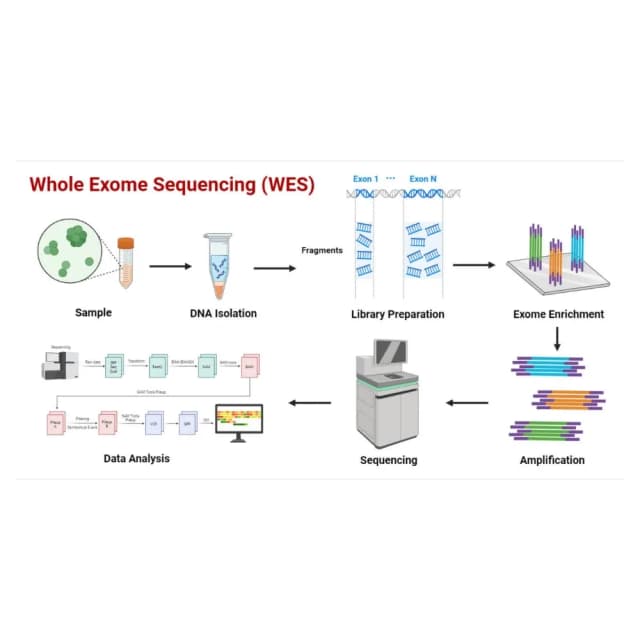
WES uses exon enrichment: probes hybridize exon sequences to capture protein-coding regions from an adapter-ligated library. The enriched exons are sequenced on high-throughput platforms to obtain coding detail, then analyzed to identify variants that may affect protein function, aiding the study of genetic diseases.
Literature
Published in 2021, "Exome sequencing and analysis of 454,787 UK Biobank participants" analyzed protein-altering variants (missense, nonsense) in 454,787 UK Biobank participants via WES. WES found 12 million coding variants (1M loss-of-function, 1.8M damaging missense), with 564 genes significantly associated with 3,994 health traits (liver, eye, cancer, blood pressure). For example, SLC9A3R2 variants lower hypertension risk; MAP3K15 and FAM234A lower diabetes risk; SLC27A3 lowers asthma risk. Rare exonic variants (e.g., SLC9A3R2 loss-of-function) are key drivers of some traits, providing biomarkers; combined with functional assays, WES clarifies gene function (e.g., MAP3K15 in insulin signaling) for disease mechanisms.
Experiment Flow
DNA extraction
typically from blood or saliva, followed by purity and integrity QC.
Library construction
shear DNA into fragments and ligate barcoded adapters to each sample.
Exon capture
biotinylated probes hybridize with targets and pull down exon regions.
Sequencing
read bases at high depth on a high-throughput sequencing platform.
Data analysis
identify and annotate variants from massive data by standard pipeline.
Sample Requirements
>0.1 g.
>5×10^6 cells.
>1 mL.
plasma ≥3 mL; serum ≥3 mL; CSF ≥4 mL.
5–10 μm, >25 mm² tissue, 10 sections.
total >500 ng.
Deliverables
QC report
depth (avg coverage ≥100×), uniformity (≥95% of targets at ≥4×), yield and contamination (adapter ratio).
Variant detection & annotation
SNV, small InDel with gene name, chromosome position, type (missense, nonsense) and HGVS nomenclature; annotation against population/disease databases and predictors for pathogenicity.
Analysis & interpretation report
conclusion on pathogenic/likely-pathogenic variants vs. clinical phenotype; interpretation of mechanism, inheritance and clinical significance; validation (Sanger traces, MLPA plots).
FAQ
Capture efficiency varies by exon; with mainstream software and optimized analysis we call SNP, InDel and CNV per sample.
To filter germline mutations and avoid false-positive somatic calls, tumor and normal must come from the same individual.
Yes. Fragmentation and low input in FFPE/ctDNA are mitigated by deep exome sequencing increasing read support per variant.
