

Exosomics
Harness the tiny messengers of cell-to-cell communication to advance early disease screening and dissect precise mechanisms of action.
Exosomal lncRNA Sequencing
Exosome LncRNA Sequencing (ELRS) is a dedicated high-throughput technique for long non-coding RNAs (lncRNAs, >200 nt, non-protein-coding) in exosomes. As core intercellular-communication carriers, exosomal lncRNAs are protected by the vesicle membrane from bodily-fluid RNases, are highly stable in serum/urine, and faithfully reflect the source cell's status. Although they do not encode proteins, lncRNAs regulate target-gene transcription, sponge miRNAs (ceRNA), and modulate chromatin modifications, playing key roles in disease. Versus whole-transcriptome exosome sequencing, ELRS focuses on lncRNA (no need to cover mRNA/miRNA), concentrating sequencing resources for higher depth (≥10 G) and more sensitive low-abundance lncRNA detection; versus tissue/cell lncRNA sequencing, ELRS relies on non-invasive fluids, better for clinical monitoring and large cohorts. ELRS is now core for early diagnostic biomarkers, exosome communication mechanisms, and efficacy/prognosis evaluation, especially where tissues are hard to obtain.
Principle Introduction
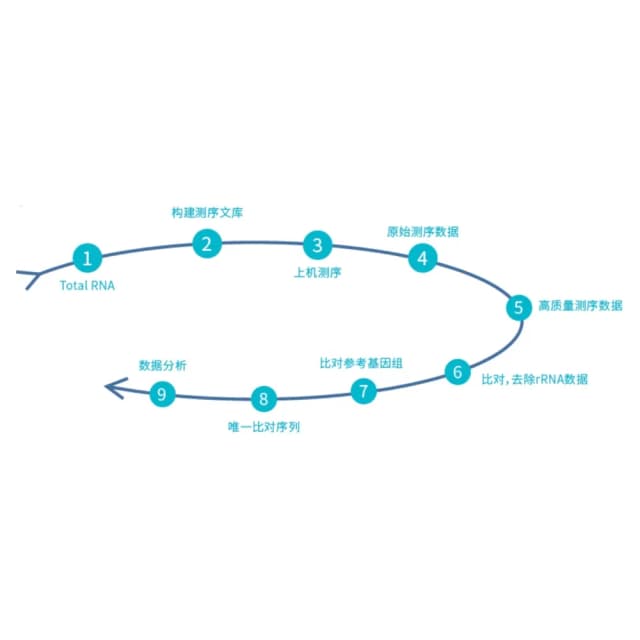
ELRS principle: exosome purification → lncRNA enrichment → targeted sequencing → functional analysis. Isolate exosomes from biofluids/supernatant and filter (0.22 μm) to remove debris and free RNA; verify purity by NTA, Western blot, and TEM. Extract and enrich exosomal RNA; build a dedicated lncRNA library by randomly fragmenting enriched lncRNA to 200–300 bp, strand-specific reverse transcription to cDNA, and adapter/index ligation; sequence on Illumina NovaSeq/MiSeq at ≥10 G clean data for effective low-abundance coverage; then construct lncRNA–miRNA–mRNA networks and mine core functions via GO/KEGG enrichment.
Literature
In Prospective Clinical Research Report, "Circulating exosomal long non-coding RNA H19 as a potential novel diagnostic and prognostic biomarker for gastric cancer" showed that serum exosomal lncRNA H19 is significantly upregulated in gastric cancer patients and correlates with tumor stage (TNM, lymph-node metastasis); preoperative H19 level serves as a novel diagnostic biomarker and postoperative decrease indicates treatment response, with important diagnostic and prognostic value. ELRS played a key "discovery-to-validation" role, identifying exosomal H19 as a novel biomarker and supporting its use via stability and clinical-correlation analysis. The study offers new ideas for non-invasive early screening and precision therapy of gastric cancer, highlighting ELRS's value in liquid biopsy.
Sample Requirements
serum ≥5 mL; plasma ≥5 mL; urine ≥10 mL; CSF ≥2 mL; saliva ≥3 mL.
≥20 mL.
≥200 μL.
total ≥50 ng.
Deliverables
QC report
exosome purity, RNA quality, sequencing quality.
lncRNA detection and annotation
expression matrix, differential analysis, database annotation.
Functional analysis
GO/KEGG enrichment plots (Top20), lncRNA–miRNA–mRNA network diagram, differential lncRNA co-expression network.
Report
conclusions (core differential lncRNA set, biomarker candidates, association strength with disease/phenotype); interpretation of regulatory mechanisms.
FAQ
Exosomes are immunophenotyped; some samples simply express a marker too low to detect, so certain WB markers may be negative—this is an exosome property, not a project-specific issue, and there is no universal rule (cell-supernatant especially is irregular; low-plasma-rate samples may fall below WB detection limits). Generally use 2–3 positive and 1 negative markers; low positive rate relates to the sample itself.
Yes. Exosomal RNA is typically ng-level; ensure reliability by: ① high-sensitivity extraction (recovery ≥80%); ② low-input lncRNA enrichment/library kits (min 10 ng total RNA); ③ raise depth to 12–15 G clean data; ④ strict filtering to reduce false positives.
